Medical Disclaimer: This article is for informational and educational purposes only and does not replace medical advice. Hair loss can have multiple causes, and treatment suitability varies from person to person. Always consult a qualified dermatologist or hair restoration specialist before starting, stopping, or changing any medication or hair restoration treatment.
When people start noticing hair fall, they usually blame stress, poor diet, nutritional deficiency, water change, shampoo, or family history. These can definitely contribute to hair loss, but in many men and women, gradual thinning is also linked to a hormone called DHT.
DHT, or dihydrotestosterone, is a natural hormone present in both men and women. It does not cause hair loss in everyone. Hair loss usually happens when scalp hair follicles are genetically sensitive to DHT. Over time, this sensitivity can cause the follicles to shrink, making thick hair thinner, weaker, and shorter.
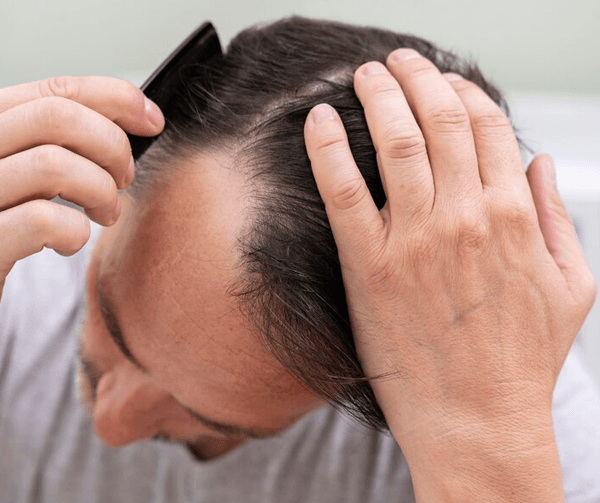
This type of hair loss is known as androgenetic alopecia or pattern hair loss. In men, it commonly appears as a receding hairline, temple thinning, or crown baldness. In women, it usually appears as widening of the hair partition, reduced volume, and diffuse thinning on the top of the scalp.
That is why a proper hair loss diagnosis is important before choosing any hair fall or hair restoration treatment. In this blog, we will explain what DHT is, how it causes hair fall, and how this hormone-linked hair thinning appears differently in men and women. For a complete overview of DHT-blocking treatments for hair loss, refer to our full pillar guide.
What is DHT?
DHT, or dihydrotestosterone, is a natural hormone made from testosterone. It is present in both men and women, but men usually have higher levels. DHT is not harmful on its own and plays a role in normal body functions such as beard and body hair growth, skin oil production, and sexual development.
The problem begins when scalp hair follicles are genetically sensitive to DHT. In such people, DHT can slowly shrink the follicles, making thick hair become thinner, weaker, and shorter over time. This gradual shrinking of hair follicles can lead to pattern hair loss in men and women.
DHT is formed from testosterone, a hormone that supports important body functions such as sexual development, muscle strength, bone health, and hair growth.
The body uses an enzyme called 5-alpha-reductase to convert testosterone into DHT. This is a normal process, and DHT is not harmful to everyone.
The problem starts when DHT attaches to scalp hair follicles that are genetically sensitive to it. Over time, these follicles can shrink and weaken. As a result, they start producing hair that is thinner, shorter, and less dense.
Clinical Insight
Hair fall caused by follicle miniaturisation usually occurs gradually and progresses over time. If it is diagnosed early, treatment is more likely to protect existing hair and slow further thinning.
How Does DHT Cause Hair Fall?
DHT causes hair fall by affecting scalp follicles that are genetically sensitive to it. These follicles are commonly present in the front, mid-scalp, and crown areas.
When DHT binds to these sensitive follicles, it can slowly disturb the normal hair growth cycle. The main change is called follicular miniaturisation. This means the hair follicle gradually becomes smaller and weaker.
As the follicle shrinks, it cannot produce thick, strong, long hair like before. Instead, the new hair becomes thinner, shorter, weaker, and less visible over time.
This is why DHT-related hair loss usually starts gradually, with early signs such as reduced hair density, a receding hairline, thinning temples, or thinning crown.
Why DHT Affects Scalp Hair Differently
DHT can support beard and body hair growth, but it may shrink scalp follicles in people prone to pattern hair loss. This happens because follicles in different body areas respond differently to the same hormone.
Scalp follicles in the front, mid-scalp, and crown are usually more sensitive to DHT. In contrast, hair on the back and sides of the scalp is usually more resistant. This is why hair thinning often starts on the top of the scalp, while the sides and back remain comparatively stronger.
DOCTOR’S INSIGHT
“The same hormone can behave differently in different areas of the body. DHT may support beard growth, but in genetically sensitive scalp follicles, it can slowly cause miniaturisation and thinning.”
How DHT Causes Hair Loss in Men
In men, DHT primarily affects hair follicles on the front hairline, temples, mid-scalp, and crown. These areas are more likely to be genetically sensitive to it. When DHT repeatedly acts on these follicles, they gradually become smaller and weaker.
As the follicles shrink, they produce thinner, shorter hair. Over time, this can lead to a receding hairline, thinning at the temples, and reduced density over the crown. This is the typical pattern of male pattern hair loss.
Common Signs in Men
- Receding hairline
- Temple thinning
- M-shaped hairline
- Crown thinning
- Reduced hair density on top
- More scalp visibility under light
Quick Insight
Men do not always have high DHT levels. In many cases, the main problem is follicle sensitivity. Hair on the back and sides is usually more resistant to DHT, which is why many men lose hair on top but retain hair at the back.
If this pattern continues, a doctor may recommend androgenetic alopecia treatment based on the stage of thinning, scalp condition, age, donor area, and long-term hair restoration goals.
How DHT Causes Hair Loss in Women
Women also produce DHT, but in smaller amounts than men. Even then, DHT can contribute to gradual thinning when scalp follicles are sensitive to it.
In women, hair loss usually does not appear as a strongly receding hairline or a completely bald crown. Instead, it often shows up as widening of the hair partition, reduced ponytail volume, and diffuse thinning over the top of the scalp.
Common Signs in Women
- Widening the hair partition
- Reduced ponytail thickness
- Diffuse thinning on top of the scalp
- More visible scalp
- Reduced overall volume
- Gradual thinning over time
Quick Insight
In women, DHT may be one factor, not the only factor. Hair thinning may also be linked with PCOS, thyroid imbalance, iron deficiency, vitamin deficiencies, menopause, postpartum changes, stress, or crash dieting. That is why a proper hair loss diagnosis is especially important in women before starting any medicine or hair restoration treatment.
DHT Hair Loss in Men vs Women
Dihydrotestosterone hair loss can affect both men and women, but the pattern is usually different. Men often notice hairline recession and crown thinning, while women commonly notice reduced hair volume and widening of the hair partition.
| In Men |
In Women |
| Usually starts with temple thinning or a receding hairline |
Usually starts with reduced volume or widening of the hair partition |
| Crown thinning is common |
Diffuse thinning on the top of the scalp is common |
| Hairline often moves backwards |
The front hairline usually remains preserved |
| Can progress to advanced baldness on top |
Complete baldness is uncommon |
| Patterns are often easier to recognise |
Pattern may overlap with PCOS, thyroid, iron deficiency, stress, or menopause |
| Treatment usually focuses on slowing the DHT effect and preserving existing hair |
Treatment depends on diagnosis because multiple causes may be involved |
Treatment for DHT Hair Loss
Treatment for hormone-linked pattern hair loss mainly focuses on three goals:
- Reducing the effect of DHT on sensitive follicles
- Strengthening existing miniaturised hair
- Slowing further thinning
The treatment plan depends on age, gender, stage of hair loss, scalp condition, medical history, and whether the follicles are still active. Early-stage thinning may respond better to medications and growth-supportive treatments, while advanced bald areas may require hair restoration options.
Common approaches may include minoxidil, PRP, GFC, lifestyle and nutritional corrections, or hair transplant in selected cases. In some patients, doctors may also consider DHT blockers for hair loss to reduce the hormone’s effect on sensitive follicles, but these medicines should be used only after medical consultation.
Treatment for DHT Hair Loss in Men
In men, treatment usually focuses on controlling the effect of androgens and preserving existing hair. If the follicles are still active, medicines and growth-support treatments may help slow progression and improve density.
Common options may include:
- Minoxidil to support hair growth and improve hair thickness
- Finasteride or dutasteride in suitable patients to reduce DHT activity
- PRP or GFC therapy to support weak follicles
- Nutritional correction if deficiencies are present
- Hair transplant if bald areas are advanced and donor hair is suitable
For men with receding hairline, crown thinning, or progressive male pattern baldness, the doctor may recommend androgenetic alopecia treatment based on the grade of hair loss and long-term restoration goals.
Treatment for DHT Hair Loss in Women
In women, treatment requires a more customised approach because androgen sensitivity may co-occur with hormonal, nutritional, or medical factors. Unlike men, female hair thinning is often more complex and may be linked with PCOS, thyroid imbalance, iron deficiency, vitamin deficiencies, postpartum changes, menopause, stress, or crash dieting.
At our clinic, female hair loss evaluation is carefully planned by experienced doctors, including Dr Aman Dua, Co-Founder and Managing Director of AK Clinics, who is known as one of India’s pioneering female FUE hair transplant surgeons and has extensive experience in hair restoration and aesthetic dermatology.
Treatment may include:
- Minoxidil
- DHT blockers for hair loss
- Anti-androgen medicines
- Iron, vitamin D, B12, or thyroid correction
- PRP or GFC therapy
- Hair restoration treatment
Safety Precautions for Women
Women should not start DHT blockers, anti-androgen medicines, or hormonal treatment on their own. These medicines may not be suitable during pregnancy, while breastfeeding, or when planning a pregnancy. The safest approach is to first understand the cause and then choose a treatment based on the patient’s scalp condition, age, medical history, and long-term hair goals.
How is DHT Hair Loss Treated at AK Clinics?
We take every hair loss case seriously because DHT-linked thinning does not look the same in every patient. A man with temple recession or crown thinning may need a different treatment approach than a woman with a widening hairline, reduced volume, or diffuse thinning.
Our dermatologists and hair restoration experts evaluate each case individually by assessing:
- Hair loss pattern
- Scalp condition
- Stage of thinning
- Medical history
- Lifestyle factors
- Donor area, if a hair transplant may be needed
- Expectations of the patient
For men, the focus is often on managing the effects of DHT, preserving existing hair, and planning for long-term coverage if the hairline or crown is progressing. For women, treatment is planned more carefully because DHT sensitivity may overlap with hormonal, nutritional, or medical factors.
Confused Whether Your Hair Loss is Due to DHT?
If you are unsure whether your hair loss is due to DHT, genetics, stress, nutritional deficiencies, hormonal imbalances, or another cause, it is best to have your scalp evaluated by a specialist.
At AK Clinics, India’s best hair restoration clinic, we deal with all types of hair loss in men and women. If you want to get your scalp assessment and consult our experts, book your consultation today via WhatsApp or by calling 97799-44207, or visit our clinical locations in Delhi, Ludhiana, or Bangalore.
Frequently Asked Questions
DHT stands for dihydrotestosterone. It is a hormone derived from testosterone and is present in both men and women. It plays important roles in the body, but when scalp follicles are sensitive to it, DHT can contribute to gradual hair thinning.
No. High DHT does not always mean hair loss. Many people have normal hormone levels but still develop pattern thinning because their scalp follicles are genetically sensitive to DHT. So, follicle sensitivity is often more important than hormone level alone.
Yes. Dihydrotestosterone-induced hair loss typically presents differently in men and women. In men, it commonly causes thinning at the temples, a receding hairline, and baldness at the crown. In women, it usually causes widening of the hairline, reduced volume, and diffuse thinning at the top of the scalp.
No. DHT blockers are not suitable for everyone. They should be used only after medical consultation. Women should be especially careful, as these medicines may not be suitable during pregnancy, breastfeeding, or while planning pregnancy.
DHT-linked thinning can often be controlled when treatment starts early. If follicles are still active, treatment may help improve thickness and slow further thinning. If follicles have been inactive for a long time, hair restoration treatment may be considered on a case-by-case basis.
You should visit a dermatologist or hair restoration doctor if you notice progressive thinning, a receding hairline, crown thinning, widening hair partition, reduced hair volume, or a more visible scalp. These specialists can examine your scalp, identify the pattern of hair loss, and recommend whether you need medical treatment, regenerative therapy, or hair restoration.
Disclaimer: This article is for informational and educational purposes only and does not constitute medical advice. Hair loss can have multiple causes. Always consult a qualified dermatologist or hair restoration specialist before starting any medication, supplement, or hair restoration procedure. Individual results may vary.








Leave a Comment